SECUREC DEFEND
Turn security signals into prioritized action.
CAPABILITIES
What monitoring covers
- SIEM and security-tool integration
- Cloud, identity, endpoint and application signals
- Alert triage and enrichment
- Detection use-case tuning
- Investigation and escalation
- Incident workflow and evidence
- Threat and control reporting
- Post-incident recommendations
OPERATING MODEL
How the service runs
- Step 01
Identify what matters
Critical assets, identities and data flows established first.
- Step 02
Connect telemetry
Connect the agreed sources—no silent collection beyond scope.
- Step 03
Baseline and detect
Establish detection rules and baseline behavior.
- Step 04
Triage and enrich
Security alerts triaged and enriched before anyone is paged.
- Step 05
Escalate
Escalate using agreed severity definitions and contact paths.
- Step 06
Coordinate response
Containment or response coordinated according to authorization.
- Step 07
Review and improve
Review trends, coverage gaps and improvement actions.
SERVICE-LEVEL CLARITY
What we will not claim
To be confirmedActual monitoring hours and coverage calendar — stated in the service agreement, not implied by a “24×7” badge.
To be confirmedAcknowledgement and escalation targets the delivery team can meet.
To be confirmedEscalation channels and named contact paths.
To be confirmedResponse authority — what we may act on directly versus what needs your approval.
To be confirmedCustomer dependencies: log sources, access, and who is reachable out of hours.
To be confirmedExplicit exclusions.
Signals ingested
1.2M
Last 24 hours
Raised to analysts
18
After correlation
Open investigations
3
1 high severity
| ID | Signal | Source | Severity | State |
|---|---|---|---|---|
| AL-8812 | Impossible travel on privileged account | Identity provider | High | Under investigation |
| AL-8815 | New IAM role granted outside change window | Cloud audit log | Medium | Confirmed change |
| AL-8819 | Endpoint detection quarantined a script | Endpoint agent | Medium | Contained |
| AL-8823 | Repeated failed logins from one range | Application gateway | Low | Suppressed — known scanner |
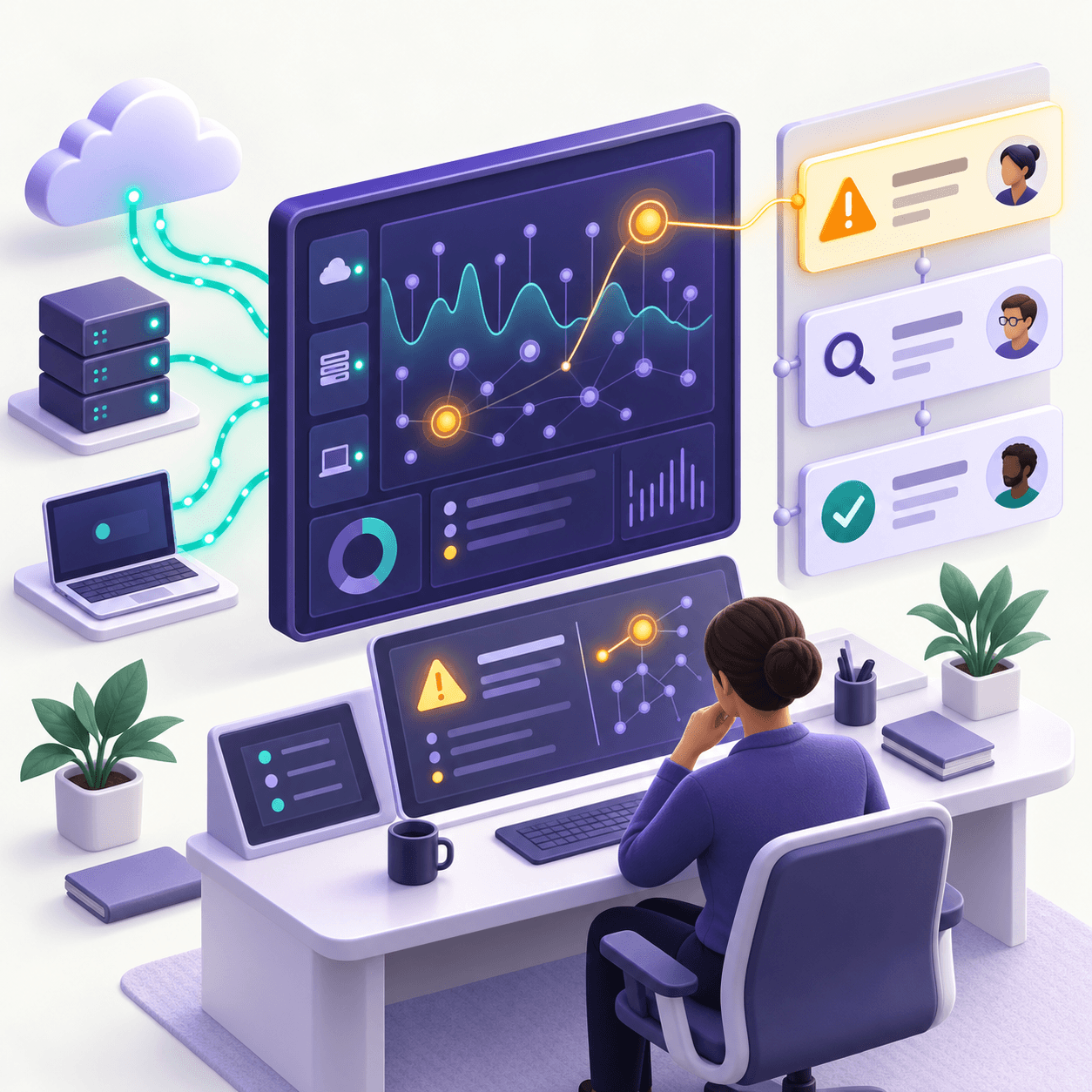
- Example alert queue with source, severity and investigation state.
AL-8812
Impossible travel on privileged account
- Source
- Identity provider
- Severity
- High
- State
- Under investigation
AL-8815
New IAM role granted outside change window
- Source
- Cloud audit log
- Severity
- Medium
- State
- Confirmed change
AL-8819
Endpoint detection quarantined a script
- Source
- Endpoint agent
- Severity
- Medium
- State
- Contained
AL-8823
Repeated failed logins from one range
- Source
- Application gateway
- Severity
- Low
- State
- Suppressed — known scanner
Routine events stay muted so analysts work the signals that matter. Every state change keeps its reasoning and owner.
FRAMEWORK RELEVANCE
Where monitoring earns its place
- SOC 2 Type II: operating evidence across the examination period
- ISO 27001: logging, monitoring and incident-management controls
- India: logging, time synchronization and incident escalation readiness
- Customer security reviews: evidence that detection actually runs
QUESTIONS
Common questions
Can SecureC replace our existing SIEM?
Does monitoring include remediation?
What information is needed for onboarding?
Tell us what you are working toward.
Send us a few details and the SecureC team will get back to you to talk through your scope, obligations and the practical next step.
Related reading
- VAPT and security testing
Find the weaknesses before monitoring has to catch them.
- Compliance readiness
Where monitoring records become control evidence.
- India: DPDP and CERT-In
Logging, retention and incident escalation expectations.
- How SecureC secures itself
Our own controls and disclosure process.
- Contact Us to Get Started
Agree coverage, escalation and response authority.